1. Logistics, Customs Clearance, and Risk Transfer
Purchasing mining hardware directly from manufacturers or distributors involves international shipping, which comes with specific risks—ranging from transit damage to customs delays.
When using 2Bminer's services, this process is structured to fully protect the customer from these initial risks:
- Supply Chain Management: The company handles complete logistics, customs declarations, paperwork, and duty payments.
- Ownership and Responsibility: Throughout shipping, customs clearance, and installation, the machine remains the property and responsibility of 2Bminer. If any hardware damage or technical complications occur before startup, the company bears all risks and handles communication with the manufacturer.
- Handover into Operation: The customer takes ownership of the machine only at the exact moment it is successfully connected to the network. At that point, the hardware has been fully checked, stable firmware is installed, the cabling is properly managed, and the machine is ready to run.
2. Infrastructure and Hosting Location
The key factors for mining profitability are electricity prices and the quality of the facility where the hardware runs. In Europe, high energy prices often make home mining uneconomical. Industrial mining therefore relies on what is known as hosting in dedicated technology centers.
- Geographic Location: Machines are placed in regions with an abundance of cheap energy. A prime example is Washington State in the USA, where surplus electricity from hydroelectric power plants is utilized. This ensures low operating costs while reducing the environmental footprint of the mining operation.
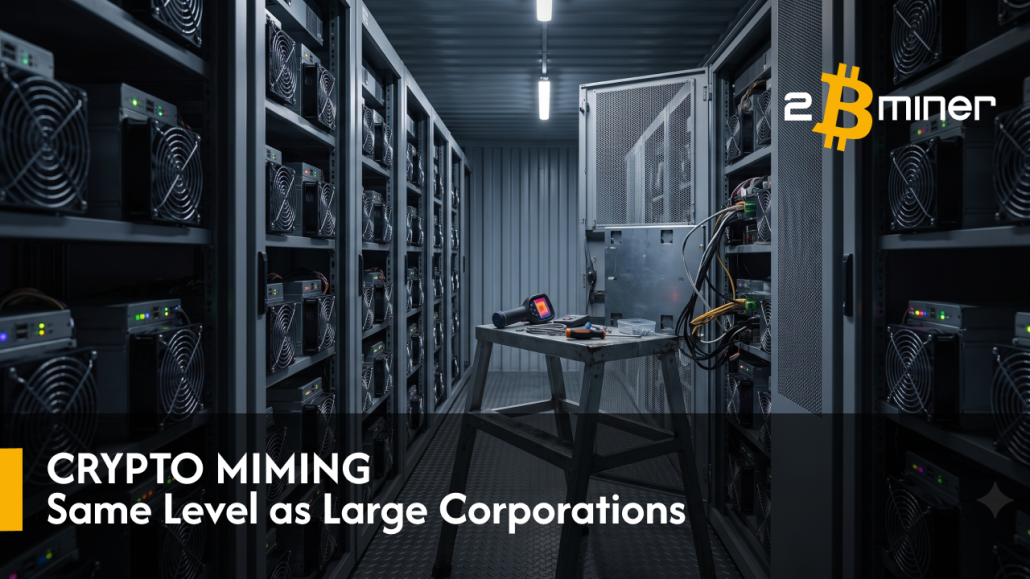
- Technical Facilities: ASIC miners are high-performance computers that generate a significant amount of heat. Professional hosting centers are therefore equipped with industrial cooling, advanced dust filtration, 24/7 physical security, and robust network protection against cyber threats.
3. Operational Service and Troubleshooting Technical Downtime
Mining hardware operates 24/7/365, which naturally leads to component wear and tear. When it comes to handling technical downtime and maintenance, there is a fundamental difference between managing it yourself at home versus utilizing industrial hosting.
DIY Home Mining
When mining at home, the entire technical and logistical burden falls on the operator. If a machine stops, the owner must first diagnose the fault themselves to find out whether the power supply, control board, or the hashboard itself failed. Next comes the need to communicate with the manufacturer's service department, which often takes place in a foreign language with support based in Asia.
The damaged part must then be uninstalled, shipped abroad at the owner's expense, and clear customs upon its return. During these weeks or even months, the machine isn't mining, which extends the return on investment while any fixed costs for space or loans keep piling up.
Industrial Hosting
In a professional environment, the process is completely different. Outages or anomalies are automatically detected by a monitoring system, and on-site technicians at the data center respond immediately. Diagnostics, preventive cleaning, and actual repairs are handled directly by the service team. If a damaged component needs replacing, it is often done within hours. The customer completely avoids technical communication in multiple languages, packaging shipments, and paperwork, reducing forced downtime to an absolute minimum.
4. Economic Model and Aligning Incentives
The financial cooperation between the customer and the service provider is built on the principle of shared success. 2Bminer does not charge fixed monthly management fees, nor does it invoice for individual technician tasks or spare parts.
- Success Fee: The company's commission is 20% of the actual amount of cryptocurrency mined. If a machine is not mining due to a breakdown or maintenance, the company generates zero income. This model ensures that both parties share the exact same interest: maximizing efficiency and minimizing hardware downtime.
- Predictable Costs: When purchasing a machine, the customer pays for the hardware and energy for 1 year in advance. This acts as an electricity price lock, eliminating the risk of sudden market fluctuations during the year.
Steps to Start Mining
For the end user, the process of getting involved in industrial mining is standardized into three simple steps:
- Hardware Selection and Contract: The customer chooses a specific type of ASIC miner and signs the contract online.
- Payment: Payment is made for the selected equipment and the fixed energy package for the first year.
- Monitoring Operations: Once the machine is physically plugged in at the data center, the customer tracks the device status and daily mining statistics via the client area (Dashboard). The mined cryptocurrency is credited directly to the user's wallet every day.