
1. Inelastic Supply
Gold is a fascinating asset, but it has one fundamental weakness: its supply is elastic over longer time scales. When the price of gold skyrockets, it becomes profitable for mining companies to open inefficient mines or extract from the ocean floor. The result is increased production, which eventually pushes the price back down.
Bitcoin has a built-in mechanism called the Difficulty Adjustment. This is likely the most important algorithm in economic history. Regardless of how many miners join the network or how high the price climbs, the network always adjusts the difficulty so that blocks are mined on average every 10 minutes.
Bitcoin is the only asset in the world where higher demand and a higher price cannot result in a higher supply.
2. Stock-to-Flow: The Definition of Digital Scarcity
In investment circles, the Stock-to-Flow (S2F) ratio is used to measure scarcity. It compares the total existing supply of an asset (Stock) with its annual production (Flow). It is expressed in years and indicates how many years it would take, at current production levels, to create the same amount of the asset that already exists today. The higher this number, the more monetarily scarce the asset is.
- Gold has a high S2F (approx. 60 years), as annual mining accounts for only a fraction of the total supply.
- Bitcoin, following the 2024 halving, has an S2F of approximately 120 years.
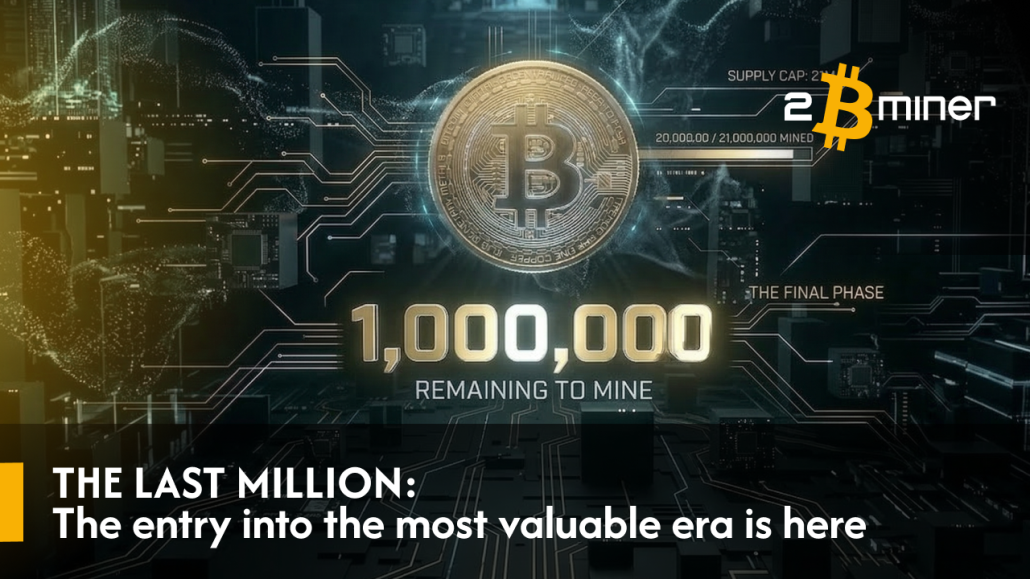
Furthermore, we know that one day the "flow" will be 0 and the "stock" will be 21 million, meaning Bitcoin's S2F tends toward infinity in the long run. The remaining 1 million BTC will be released at an incredibly slow pace over the next 114 years. This is not a bug in the system; it is the very definition of absolute scarcity.
3. Mining as a Service to the Network
The purpose of mining is transforming during this phase. While the early years were about the massive distribution of "material" (known as the Block Subsidy), with the last million, the focus is shifting toward transaction fees.
A miner today is not just a coin collector. They are an infrastructure operator for an independent financial system. As institutional adoption grows and the tokenization of assets on the Bitcoin network progresses, the value of every confirmed block will grow due to fees. Mining while the last million remains means building a position in a network that is becoming the backbone of global finance.
4. Gold and the Halving
Imagine "Halving" as an event where, every four years, half of all gold mines globally were shut down, and the remaining ones operated at half efficiency for the same cost. A crazy thought? For gold, it's impossible; for Bitcoin, it's reality.
This supply-side pressure, combined with the digital nature of BTC, instant verifiability, zero storage costs compared to physical gold, and divisibility into Satoshi - creates immense upward pressure on the price.
5. Battle of Epochs: 100 Years of Gold vs. 15 Years of Bitcoin
To understand where we are headed, we must look at how both assets appreciate over time. If we began drawing both curves at the same starting point (Index 100), we would see two completely different worlds:
- Gold (1926–2026): One hundred years ago, an ounce of gold sold for roughly $20.67. Today, in March 2026, it hovers around $2,800. This represents a respectable increase of approximately 13,445%. Gold fulfilled its role as a store of value—protecting wealth from inflation—but its growth is linear compared to the digital age.
- Bitcoin (2011–2026): If we look at Bitcoin in 2011 (approx. 2 years after its inception) when the market began to form, one coin cost roughly $1. Today, in March 2026, the price is $70,000. That is an increase of an incredible 6,999,900%.
While gold needed a century for solid appreciation, Bitcoin, driven by Metcalfe’s Law (the value of a network grows with the square of the number of its users) and absolute mathematical scarcity, has achieved something in fifteen years that history has never seen. Gold represents analog certainty; Bitcoin represents a new era.
Conclusion: The Last Million
Mining part of the last million BTC is like owning mining rights in the most lucrative neighborhood of the future digital world. It is no longer just about "having Bitcoin"; it is about "being part of the mining layer" that keeps this system running.
While the first 20 million were about distribution, the last million is about scarcity, validation, and the definitive confirmation of Bitcoin as a global standard. The argument that "there is almost nothing left to mine" does not hold up. Mining will continue for the next 114 years, and the share of transaction fees will continue to increase. Therefore, the role of miners will certainly not diminish as more Bitcoins are mined. Satoshi Nakamoto knew what he was doing, he gave us enough time for adoption but saved the greatest scarcity for the end.